Harness · private developer preview
Making a business programmable.
Harness is the technology we are building alongside our client work. It keeps the company model: one lasting ontology of how a business works, its customers, jobs and invoices and how they connect. Software and AI read from it and act through it, and nothing changes without a person's approval. Today it helps us deliver more reliable client work; it is in private developer preview, not a product you can buy.
- Sources
- The systems the business already runs: accounting, CRM, orders, suppliers. Each is declared with what it may say.
- The company model
- Customers, invoices, orders and suppliers, and how they connect: the ontology. A customer in the CRM and in accounting is one object.
- Approvals
- A model reads what it may see and can propose. Fixed rules check the proposal. The owner approves, then releases it.
- The ledger
- Every step is written down and never overwritten.
01How it learns
Access to data is not an understanding of the business.
A model with API access starts every session from nothing, and picks a side when two systems disagree. With Harness, an agent surveys the systems an owner authorizes, drafts the company model and checks it against the data. Only the owner can approve the model and put it to use.
- 01InspectSurvey what each system the owner authorizes holds: tables, columns, a few sample rows.
- 02DiscoverFind the likely customers, invoices and orders, and the links between systems.
- 03ModelWrite the company model down as a contract: the versioned ontology Harness enforces.
- 04ValidateCheck the model against fresh data. Ask a person when the data cannot decide.
- 05EvolveRevise the model as the business changes, keeping its history.NextAgent-proposed revisions
02How it acts
Five records, not one call.
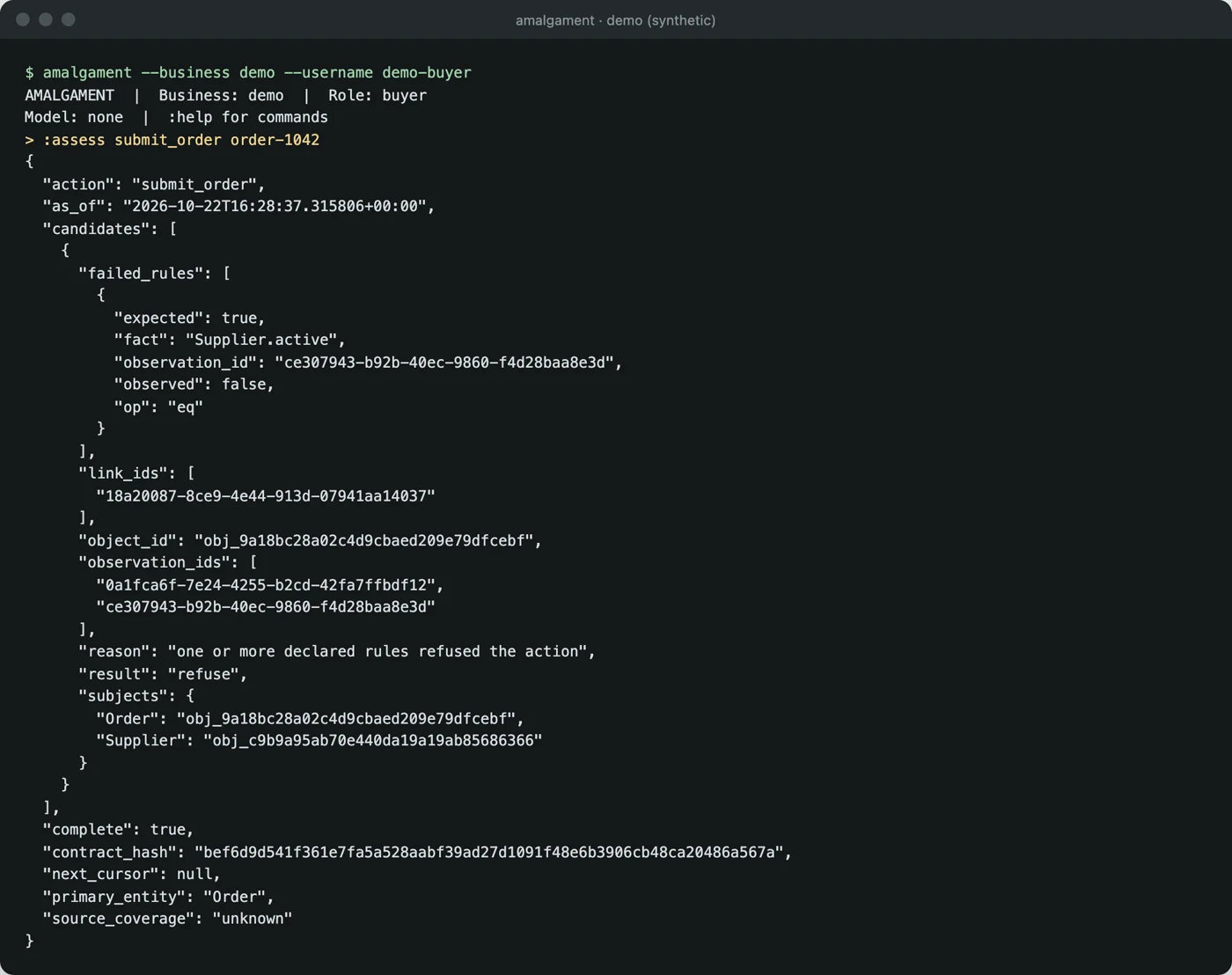
A model may propose an action. Fixed rules check it and name the fact that decides. The owner approves, then releases it. The provider's receipt and the observed outcome are kept apart, because they prove different things.
- 01 Propose
- Model or personNames what it acts on.own record
- 02 Check
- Fixed rulesAllow, refuse, or ask for more evidence.
- 03 Approve
- OwnerTied to the evidence the owner saw.own record
- 04 Release
- OwnerIt runs.own record
- 05 Receipt
- ProviderThe call was accepted.own record
- 06 Outcome
- Independent sourceThe business changed.own record
03Build on it
Your models change. The business doesn't.
The terminal, the API, the SDK and the model's tools all call the same operations. Swap the AI model, or run with none, and the company model, the rules and the history stay the same.
- Ways in
- Terminal, CLI, HTTP API, Python SDK, the model's 22 tools and a local MCP bridge. A hosted MCP endpoint is planned.
- One set of operations
- Every way in calls the same service, over the same kernel: contract, identity, ledger, rules and actions.
- Models
- Set in a file: any OpenAI-compatible model or Anthropic. Or none: every :command still works.
04Status
What works today.
Harness is proprietary. No part of it is publicly released or licensed today. It runs locally from a checkout, on made-up test businesses.
- Main branch
- 937608f464 tests passing
- Development branch
- e66bb71856 tests passing, not yet merged
- Last verified
- 2026-10-21against the code
- Runs on
- Python 3.11+loopback, SQLite
05Start building